
The Secret Life of Plants
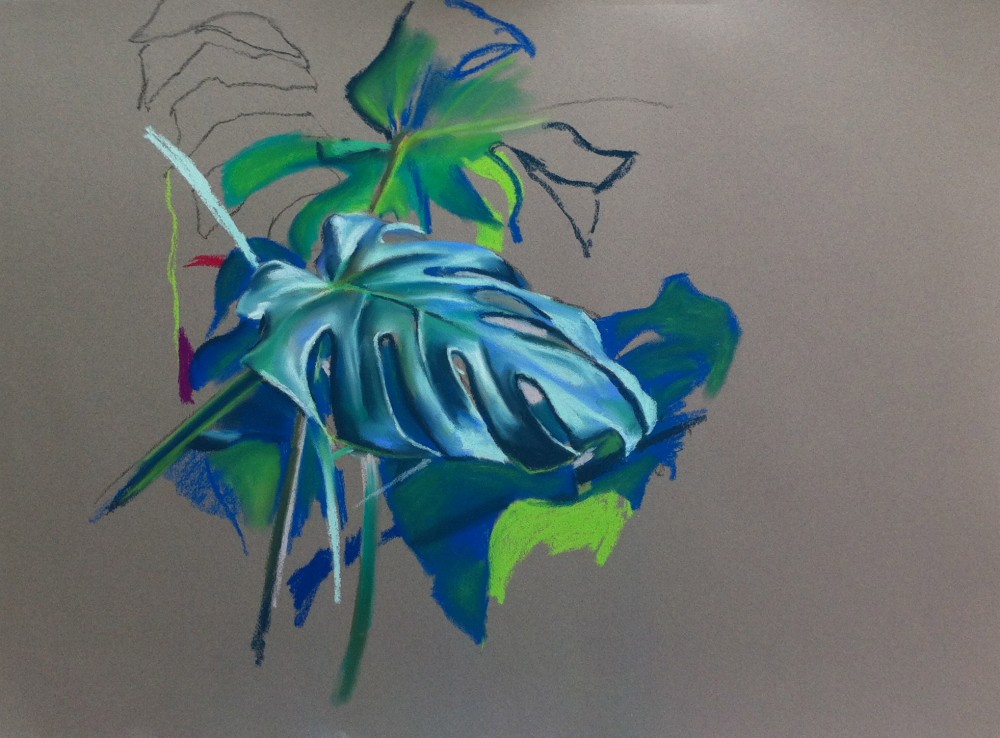
Monstera Deliciosa (Swiss cheese plant), Pastel on Paper, 21 x 30 inches
I have painted and drawn a lot of plants in my studio. I have not always been very good with them. Sometimes I don’t give them enough water, sometimes too much. Other times they have to suffer long periods of central heating. But they are good to have around because they are more like people than any other ‘thing’. I don’t mean that they feel emotions – I just mean that they are characterful, and become more so with time. I don’t particularly like cats, but I think they are beautiful to watch, and plants are similar in that they have an incredible range of movement, and when I draw them I can see them moving from one hour to the next. It might in some sense be ‘easier’, but it is a lot less fun to draw something that is not moving at all, which is why I prefer to always have something organic in a still life – even an apple is constantly changing. The thing that changes most obviously is a landscape, but often painting a portrait is a similar experience, which is why dividing things into genres – portrait, still life, nude, landscape – is so artificial: there is a landscape in every portrait and a portrait in every landscape.
While I was drawing my Monstera, someone suggested I read ‘The Secret Life of Plants’, a charming but nutty book, largely inspired by the work of Cleve Baxter, a polygraph instructor and one time interrogator for the CIA, who one day decided to do a polygraph test on the Dracaena Massangeana in his office (as one does). The original purpose was not to see whether the Dracaena was telling the truth or not (you only need to take one look at a Dracaena to see that they are perfectly honest) – but to test how quickly water travelled from the roots to the leaves. This simple aim soon yielded extraordinary and unexpected results: the Dracaena could read Baxter’s mind – whenever Baxter entertained nasty thoughts towards it, like wanting to burn one of its leaves, the polygraph went crazy. Further experiments on other plants revealed that they could tell what Baxter was thinking even when he was hundreds of miles away from them.
What must my Monstera have been thinking every time I forgot to water it? I suddenly felt very guilty, but at the same time it was comforting to think that the three potted plants in my studio always knew my state of mind. I started looking after them more, watering them regularly, lovingly wiping the dust from their leaves so that they could photosynthesize more freely.
Dogs are loyal, cats are graceful, but plants are discreet and never impose on you – so it’s worth looking after them.
Note: you can now follow this blog without signing up to WordPress, just scroll down to the bottom and click on ‘follow’. It will just ask for your email address, and you’ll get a notification each time I post.
The Meaning of Trees (and how to avoid military service)
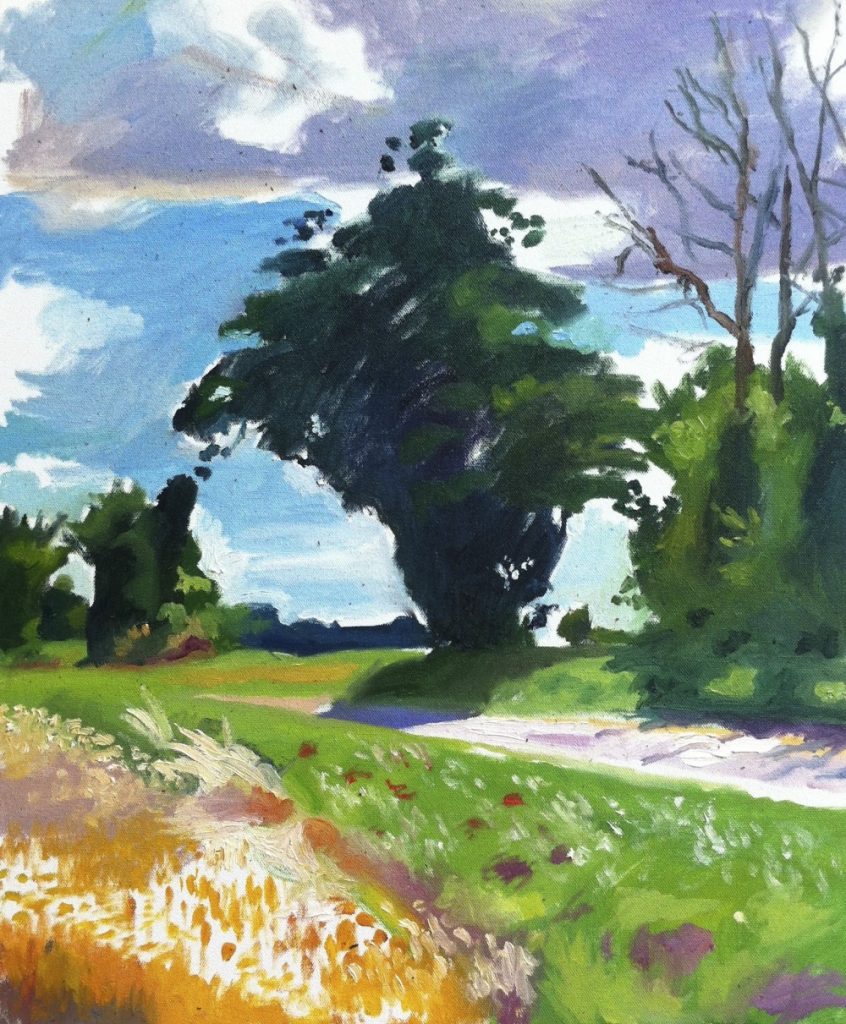
Tree Near Ramsholt, Oil on Canvas, 32 x 22 inches
Another painting from Suffolk. It made me wonder why I zero in on particular trees. When I see a tree like this I find it almost irresistible. An uncle of mine, a psychologist, told me he was once approached by a young man who asked him how to get out of military service (this was in Poland back in the eighties). Simple, he said, when you come before the evaluation board, tell them that you got there on foot, that you had a very nice walk in the park, that there was a particular tree in the park that caught your attention, and that you couldn’t help feeling that it was trying to tell you something… The advice worked: he was turned down by the evaluation board.
This painting is a bit more colourful than some of my other landscapes. I think I was influenced at the time by David Hockney’s pictures of Yorkshire.
Suffolk Landscape

Suffolk Landscape, Oil on Canvas, 32 x 20 inches
View of Bawdsey Peninsula from Ramsholt, Oil on Canvas, 20 x 32 inches
This is a view of Bawdsey Peninsula which I painted alongside my friend Charles Macdonald in September this year. I’ve been painting landscape with Charlie and a group of other friends for the last couple of years. We’ve been to many different places, but this has to be one of the most spectacular views. Somewhere to the left on the horizon is where the River Deben opens out on to the North sea, and if you had bionic eyesight that could also follow the curve of the earth, you would be able to see all the way to the Hague in the Netherlands. We painted the view earlier in the summer before the harvest when everything was golden brown, but the post-harvest view seemed even more interesting with the tractor marks in the field. As we drove into this part of Suffolk I was taken aback by how much it reminded me of Poland (the sandy soil, the cedar and birch trees), and Charlie pointed out that that made perfect sense: it’s all part of the North German peninsula.
Recent Comments